A clogged sink or a sluggish toilet is an everyday inconvenience. But when your home’s main sewer line backs up, it is a full-blown plumbing emergency.
Every drain fixture in your house—toilets, showers, sinks, washing machines, and dishwashers—relies on a single, continuous 3-to-4-inch main sewer lateral pipe to carry wastewater from your foundation out to the municipal sewer main or private septic tank.
When this primary arterial pipe becomes obstructed by invasive tree roots, grease buildup, or broken pipe segments, thousands of gallons of wastewater have nowhere to go but back up into your home’s lowest plumbing fixtures.
This guide breaks down the telltale warning signs of a main sewer line clog, how to locate your cleanout port, and why heavy-duty motorized drain snaking is the primary method plumbers use to restore flow.
The Primary Warning Signs of a Main Sewer Blockage
Unlike a isolated fixture clog (such as hair caught in a shower drain), a main line blockage causes system-wide hydraulic symptoms across multiple fixtures simultaneously:
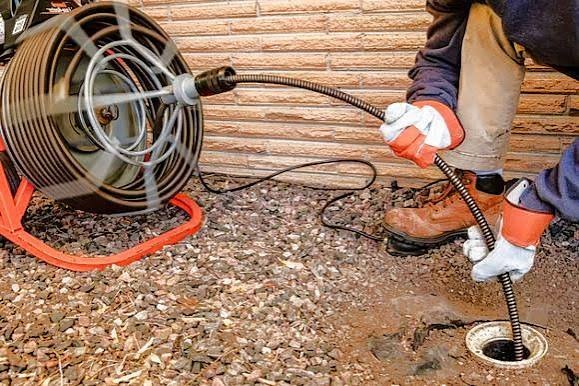 Figure 1: A licensed plumbing technician clearing tree roots and solid obstructions by feeding a heavy-duty motorized drum snake auger cable directly through an exterior cleanout pipe.
1. Cross-Fixture Reactions
When water cannot drain down the main lateral, air and wastewater are forced backward into adjacent fixtures:
- The Washing Machine Test: When your washing machine enters its high-volume drain spin cycle, does water suddenly rise inside your bathtub, or does your nearby toilet begin gurgling and bubbling violently? This is the single most reliable sign of a main sewer line restriction.
- The Flushing Toilet Reaction: Flushing a bathroom toilet causes wastewater or foul air bubbles to surge upward through the shower stall drain.
2. Simultaneous Multiple Drain Backups
If only one sink drains slowly, the clog is local. However, if your basement floor drain, first-floor bathtub, and laundry standpipe are all draining sluggishly or backing up at the same time, the obstruction is located downstream in the main building sewer.
3. Distinct Sewer Gas Odors
A fully functioning plumbing system relies on sealed water traps (P-traps) and roof vent stacks to vent sewer gases safely into the atmosphere. When a main line is choked off, sewer gas pressure builds up, burping methane and hydrogen sulfide odors through floor drains and fixture seals.
Common Causes of Main Sewer Line Failures
Understanding what caused the blockage determines whether mechanical snaking, hydro-jetting, or pipe replacement is necessary:
| Cause | Pipe Material Most Affected | Recommended Clearing Method |
|---|---|---|
| Tree Root Infiltration | Vitrified clay, concrete, and older cast iron | Motorized auger with root-cutting head; pipe relining |
| “Flushable” Wipes & Hygiene Items | All pipe types (PVC, ABS, cast iron) | Heavy-duty mechanical drain snake |
| Fats, Oils & Grease (FOG) | Kitchen branches and main laterals | High-pressure hydro-jetting |
| Pipe Belly / Sag | Settled soil or shifted bedding | Excavation repair or trenchless pipe bursting |
| Channel Rot / Collapse | Corroded bottom of aging cast iron (50+ years) | Pipe lining (CIPP) or full lateral replacement |
Locating Your Main Sewer Cleanout
Before a plumber can clear a main line blockage, they need direct access to the sewer lateral through a cleanout fitting. A cleanout is a dedicated pipe with a threaded cap that bypasses household traps:
- Exterior Yard Cleanout: Most common in modern homes. Typically a 3-inch or 4-inch white PVC or black ABS pipe extending slightly above lawn level near the front foundation wall or sidewalk, sealed with a square-nut threaded cap.
- Basement / Crawl Space Cleanout: In colder climates, look along the basement floor near the perimeter foundation wall where the main cast-iron or PVC stack exits through the concrete.
- Warning Before Opening: If your household drains are actively backing up, never unscrew a cleanout plug indoors without professional containment equipment. The pipe may be pressurized with several vertical feet of standing black wastewater that will flood the room the moment the plug is removed.
Motorized Drain Snaking: How the Pros Clear the Line
When a simple handheld auger or household plunger fails, master plumbers deploy commercial-grade motorized drum snake machines (often carrying 100+ feet of heavy 5/8-inch or 3/4-inch inner-core steel cable):
┌────────────────────────────────────────────────────────┐
│             The Mechanical Snaking Process             │
├──────────────────────────┬─────────────────────────────┤
│ Step 1: Cleanout Access  │ Threaded cap removed carefully│
├──────────────────────────┼─────────────────────────────┤
│ Step 2: Tool Selection   │ C-cutter, spade, or root saw│
├──────────────────────────┼─────────────────────────────┤
│ Step 3: Rotational Feed  │ 200+ RPM motorized cable    │
├──────────────────────────┼─────────────────────────────┤
│ Step 4: Obstruction Punch│ Boring through paper/roots  │
├──────────────────────────┼─────────────────────────────┤
│ Step 5: High-Flow Flush  │ Continuous water line rinse │
└──────────────────────────┴─────────────────────────────┘- Root-Cutting Heads: Plumbers attach specialized hardened-steel blades (such as C-cutters or spiral saw blades) to the cable tip. As the motor spins the cable at 200–300 RPM, the blades slice through dense masses of tree roots clinging to pipe joints.
- Retrieving Solid Debris: The rotating corkscrew head hooks into non-dispersible debris (baby wipes, feminine products, paper towels) and pulls the compacted plug back out through the cleanout.
- Flushing & Verification: Once the snake punctures through the blockage, water suddenly drains from the home. The technician then runs a high-volume flush to sweep dislodged debris into the municipal main.
Motorized Snake vs. Hydro-Jetting: Which Do You Need?
- Choose Snaking When: Dealing with an active, standing emergency backup, localized tree root intrusions, or retrieving solid obstructions. Snaking quickly punches a hole through the plug to restore emergency drainage.
- Choose Hydro-Jetting When: Dealing with heavy grease accumulation, mineral scaling, or recurring sludge. Hydro-jetting uses 3,500–4,000 PSI water jets to scrub pipe walls 360 degrees clean, returning the line to near-original capacity.
Follow-Up: Why You Should Always Request a Sewer Camera Inspection
Clearing the immediate clog is only step one. A motorized snake will punch through a tree root blockage, but it cannot repair the cracked pipe joint that allowed the roots to enter in the first place.
Always request a high-definition sewer camera inspection immediately after the line is cleared. A fiber-optic camera pushed through the cleanout reveals:
- Exact depth and distance of structural cracks or offset joints.
- Low spots (pipe bellies) where water pools and drops sediment.
- Whether the pipe is structurally sound or requires trenchless epoxy lining (CIPP) to prevent a catastrophic collapse under your driveway or foundation.
When to Call an Emergency Licensed Plumber
A main sewer line backup is a biohazard involving Category 3 black water. If you observe water backing up into ground-floor fixtures or notice wastewater weeping around your exterior cleanout, stop running all water immediately (including dishwashers and washing machines) and contact a licensed local drain specialist equipped with commercial motorized augers and video inspection cameras.